
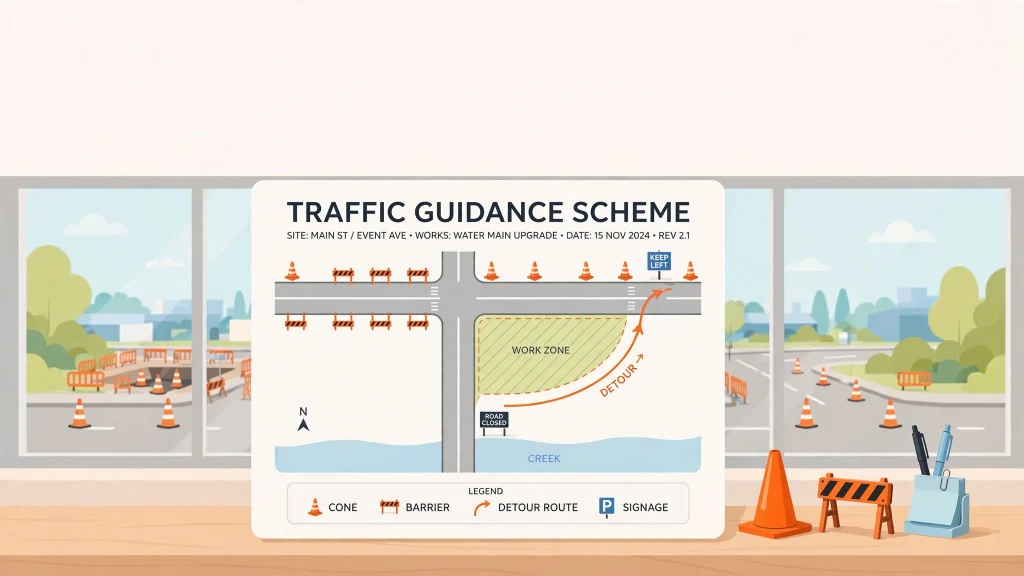
A TGS, also known as a Traffic Guidance Scheme, is a visual diagram that shows exactly how traffic control must be set up on a road or worksite. It is one of the most important operational documents used in traffic management and is relied on daily by traffic controllers, implementers, supervisors, and inspectors.
Simply put, a TGS turns planning into action.
Definition of a TGS
A Traffic Guidance Scheme is a site-specific diagram that illustrates the placement and layout of traffic control devices used to safely manage traffic during works or events.
It shows how vehicles, pedestrians, and cyclists will move through or around a worksite and how safety will be maintained while normal traffic conditions are disrupted.
If a traffic control device or arrangement is not shown on the approved TGS, it should not be installed on site.
What Does a TGS Show?
A compliant TGS clearly shows the physical traffic management setup, including:
- The direction of traffic flow
- Lane closures or lane reductions
- The placement of signs in the correct sequence
- Cones, bollards, and barriers
- Tapers and merge points
- Safety buffer zones
- Pedestrian paths and detours
- Traffic controller positions
- Temporary traffic signals or arrow boards where required
The TGS removes guesswork by providing traffic management crews with a clear visual reference.
Purpose of a TGS
The primary purpose of a TGS is to ensure traffic control is implemented safely, consistently, and in accordance with approved standards.
A well-prepared TGS:
- Guides traffic management crews during setup and removal
- Ensures traffic control arrangements match approved standards
- Reduces the risk of errors and unsafe improvisation
- Helps protect workers, road users, pedestrians, and cyclists
- Allows inspectors and supervisors to verify compliance efficiently
Without a clear and accurate TGS, even experienced traffic management crews may make unsafe assumptions.
How a TGS Differs From a Traffic Management Plan
A Traffic Guidance Scheme is often confused with a Traffic Management Plan, but the two documents serve different purposes.
- A Traffic Management Plan explains the overall strategy, risks, control measures, and responsibilities
- A Traffic Guidance Scheme shows the exact on-road layout of signs, cones, barriers, and other traffic control devices
The TMP explains what needs to happen and why. The TGS shows how the traffic controls will be physically implemented.
Both documents usually work together to support safe and compliant traffic management.
When Is a TGS Required?
A TGS is required for most works or activities that affect normal traffic movement or public access, including:
- Lane or road closures
- Works near live traffic
- The use of traffic controllers
- Temporary speed reductions
- Pedestrian or cyclist detours
- Multi-stage works
- Mobile or continuously moving works
In many cases, multiple TGSs may be required to cover different stages, work areas, or traffic management layouts.
Who Uses a TGS?
A Traffic Guidance Scheme is used by:
- Traffic management implementers during setup and removal
- Traffic controllers managing live traffic
- Supervisors overseeing site safety and compliance
- Designers preparing traffic management layouts
- Council and road authority inspectors
The TGS serves as the primary on-site reference document for the physical traffic management setup.
Why Site-Specific TGSs Matter
Using generic or copied diagrams is a common traffic management compliance failure. A TGS must reflect the actual conditions of the worksite rather than relying on a standard layout that may not be suitable.
A site-specific TGS must:
- Reflect the actual road layout and geometry
- Match the approved Traffic Management Plan
- Account for pedestrians, cyclists, intersections, and property access points
- Consider traffic speed, volume, visibility, and surrounding hazards
- Be reviewed and updated when site conditions change
A TGS that does not accurately reflect the worksite can create confusion, non-compliance, and serious safety risks.
Common Mistakes With TGSs
Common Traffic Guidance Scheme issues include:
- Using generic templates without sufficient site-specific detail
- Placing signs in the incorrect order
- Using incorrect sign spacing or taper lengths
- Failing to include suitable pedestrian or cyclist management
- Positioning traffic controllers in unsafe locations
- Failing to account for driveways, intersections, or public transport stops
- Setting up the site differently from the approved TGS
- Failing to update the TGS when conditions or work stages change
These mistakes can result in non-compliance, unsafe conditions, permit issues, or stop-work directions.
Summary
A Traffic Guidance Scheme is a critical traffic management document that visually shows how traffic control must be set up on site. It provides clear instructions for traffic management crews, supports regulatory compliance, and plays a major role in protecting workers and the public.
In traffic management, a well-designed and correctly implemented TGS is not optional. It is essential for safe, compliant, and effective operations.
The Traffic Plans Company specialise in quality traffic management plans and planning around Melbourne and other areas of Australia.
