
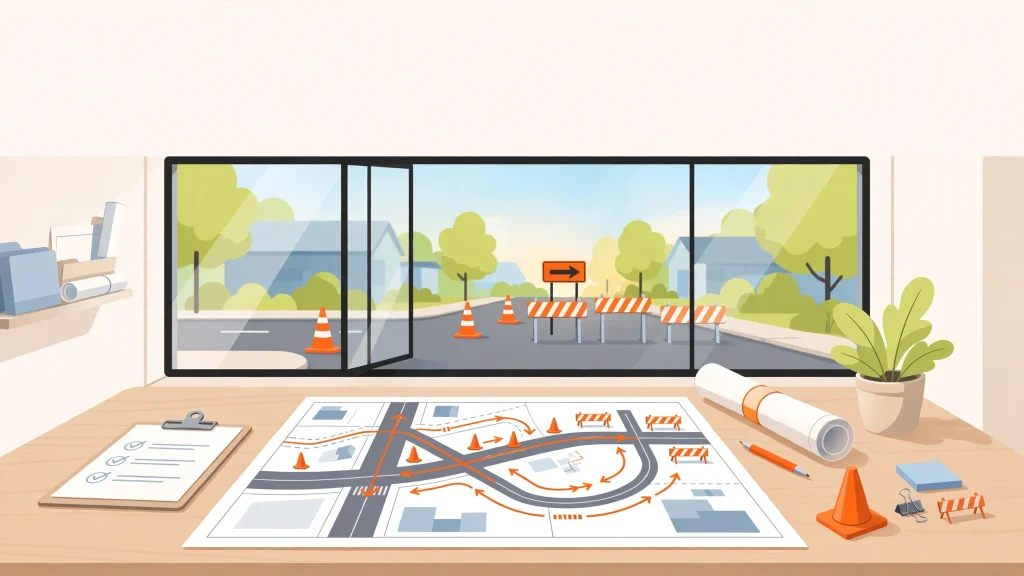
A Traffic Management Plan is a critical safety document used to manage risks to workers, road users, pedestrians, and cyclists when works affect normal traffic conditions. A well-prepared TMP is not just a formality. It is a practical tool that guides how traffic is controlled safely and legally on site.
This guide explains how to create a Traffic Management Plan step by step, from the initial assessment through to approval and implementation.
Step 1: Understand the Scope of Works
Before writing a TMP, clearly define what the work involves.
Key details to confirm include:
- Location and road name
- Type of work being carried out
- Duration and working hours
- Whether the work is short-term, long-term, or mobile
- Impact on traffic lanes, footpaths, parking, and property access
A TMP cannot be accurate unless the scope of work is clearly understood.
Step 2: Identify Road Ownership and Authorities
Determine who manages the road where the work will occur.
The responsible authority may be:
- A local council
- A state road authority
- A private road owner
Road ownership affects the approval process, permit requirements, and applicable standards. The TMP must align with the requirements of the controlling authority.
Step 3: Conduct a Site-Specific Risk Assessment
A site-specific risk assessment is the foundation of a compliant TMP.
Potential hazards may include:
- Traffic speed and volume
- Limited sight distance, bends, or curves
- Pedestrian and cyclist interaction
- Nearby schools, businesses, or public transport stops
- Weather, visibility, and lighting conditions
Assess the likelihood and potential severity of each risk, then identify appropriate control measures.
Step 4: Apply the Hierarchy of Control
Control measures must follow the hierarchy of control, beginning with the most effective options.
This may involve:
- Eliminating interaction with live traffic where possible
- Substituting the work method with a safer alternative
- Applying engineering controls, such as barriers and physical separation
- Using administrative controls, such as signage, procedures, and traffic management plans
- Using personal protective equipment as the final line of defence
A strong TMP prioritises physical separation and engineering controls rather than relying on signs or personal protective equipment alone.
Step 5: Define Traffic Control Measures
Clearly describe how vehicle traffic will be managed throughout the work area.
Include details about:
- Lane closures or lane reductions
- Temporary speed reduction zones
- Detours and alternative routes
- Contra-flow arrangements
- Traffic controllers, temporary signals, or other control devices
All traffic control measures must be realistic, clearly documented, and appropriate for the conditions at the site.
Step 6: Plan Pedestrian and Cyclist Management
Pedestrian and cyclist safety must be specifically addressed within the TMP.
The plan should include:
- Continuous and accessible pedestrian routes
- Safe crossings and clearly marked detours
- Protection from live traffic and work activities
- Consideration for prams, wheelchairs, and mobility aids
- Safe routes for cyclists travelling through or around the worksite
Pedestrian and cyclist management should never be treated as a secondary consideration.
Step 7: Define Roles and Responsibilities
A TMP must clearly state who is responsible for each aspect of traffic management.
Relevant roles may include:
- Traffic controllers
- Traffic management implementers
- Supervisors
- Traffic management designers
- Site managers
Clearly defined responsibilities reduce confusion, improve accountability, and support compliance on site.
Step 8: Include Traffic Guidance Schemes
Traffic Guidance Schemes support the TMP by visually showing how signs, cones, barriers, and other traffic control devices will be positioned.
Each TGS should:
- Match the written controls described in the TMP
- Be specific to the worksite rather than generic
- Clearly show signs, cones, barriers, tapers, and safety zones
- Reflect the actual road layout and geometry
- Show pedestrian and cyclist routes where applicable
A TMP without accurate and site-specific Traffic Guidance Schemes is incomplete.
Step 9: Document Emergency and Incident Procedures
Every TMP must explain what should happen if an incident or unexpected situation occurs.
Include procedures for:
- Vehicle incidents or crashes
- Emergency vehicle access
- Traffic control equipment failure
- Severe weather or sudden changes in conditions
- Public complaints or reported safety concerns
Clear emergency procedures allow site personnel to respond quickly and safely.
Step 10: Review, Approve, and Communicate the TMP
Before work begins:
- Review the TMP for accuracy and completeness
- Submit it to the relevant council or road authority for approval where required
- Ensure all permit and approval conditions are incorporated
- Brief all site personnel on the TMP and their responsibilities
- Confirm that the approved controls can be implemented safely on site
A TMP is only effective when the people responsible for implementing it understand and follow its requirements.
Step 11: Monitor and Update the TMP During Works
Traffic conditions, site layouts, and work activities can change throughout a project.
During the work, traffic management personnel should:
- Monitor traffic behaviour and site safety
- Check that signs and control devices remain correctly positioned
- Update controls when conditions change
- Amend the TMP when the work scope or site layout changes
- Obtain approval for changes where required
A TMP is a live document, not a set-and-forget exercise.
Common Traffic Management Plan Mistakes to Avoid
Common mistakes include:
- Using generic or copied TMPs that do not reflect the site
- Ignoring pedestrian and cyclist safety
- Failing to match the on-site setup to the approved plan
- Not updating the TMP when conditions or work activities change
- Using inaccurate or outdated Traffic Guidance Schemes
- Treating the TMP as paperwork rather than a practical safety tool
These mistakes can lead to non-compliance, approval delays, site shutdowns, and serious safety incidents.
Summary
Creating a Traffic Management Plan involves understanding the work, identifying site-specific risks, applying effective controls, and clearly documenting how traffic will be managed safely.
A strong TMP protects workers and the public, supports legal and regulatory compliance, and helps projects run smoothly.
When prepared and implemented correctly, a TMP is not just a project requirement. It is the backbone of safe traffic management.
The Traffic Plans Company specialise in quality traffic management plans and planning around Melbourne and other areas of Australia.
